
Meal planning & food diary
A Practical Guide to Meal Planning at Home
Build balanced meals from what your market already sells, and keep a food diary that makes your consultation more useful.
Start from a meal, not a diet
Most people plan backwards. They pick a target, then try to force their kitchen to match it. Work the other way. Write down the five or six dishes your household eats most often, then look at what each one is missing. If the fried rice has no vegetables, that is a specific fix. If dinner is mostly rice with a small piece of protein, that is another. Two or three adjustments to existing meals beat a new menu nobody wants to cook.
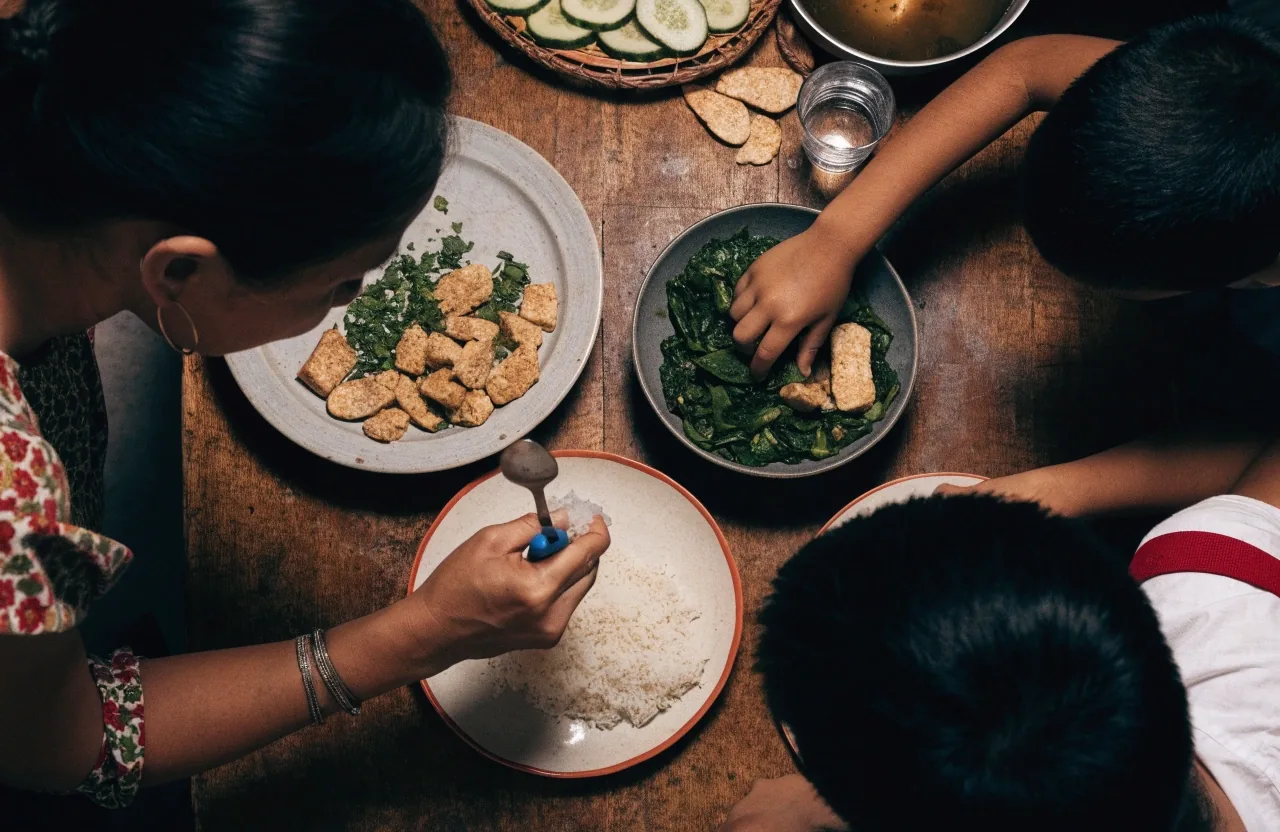
This is the part of gizi seimbang that people find hardest, because it asks you to look honestly at the plate in front of you before anyone hands you a pola makan to follow. Take a photograph of an ordinary Tuesday dinner. Then take one of a Sunday dinner. The difference between them usually tells you more than a week of guessing does, and it is exactly the kind of detail a dietitian can work with.
Work in this order
- List the dishes you cook most Five or six
- Mark what each dish is missing One, usually
- Fix the smallest gap first Vegetables, often
- Change two dishes, not ten Then cook it again
Keep the notes. They become the opening of your first session instead of a vague memory of the last few weeks.

The balanced plate
The parts of a balanced plate
A useful working structure: a staple, a protein source, vegetables, and fruit somewhere in the day. Staples include rice, noodles, bread, cassava, and potato. Protein comes from fish, eggs, chicken, tempeh, tofu, and beans. Vegetables can be cooked or raw, and the portion matters less than whether they appear at all. Fruit does not have to be a separate ritual. A banana with breakfast counts.
Staple
Rice, noodles, bread, cassava, potato. The base that carries the meal, not the whole of it.
Protein
Fish, eggs, chicken, tempeh, tofu, beans. Local and fresh is the practical choice most weeks.
Vegetables
Cooked or raw. Whether they show up matters more than how much lands on the plate.
Fruit
Anywhere in the day. A banana at breakfast is enough; it does not need its own ceremony.
Using porsi makan without a scale
Precise weighing is not practical for most households, and it is not the point of the first session either. Use your own plates and hands as references instead. A palm-sized portion works as a rough guide for protein. A cupped hand is a reasonable starting point for rice or noodles, adjusted by age and activity. Vegetables can take up more of the plate than you might expect. These references are approximate, and your dietitian will adjust them for your household rather than handing you a fixed chart.
Palm
A starting reference for fish, eggs, chicken, tempeh or tofu. Thickness counts as much as width, so a thin fillet reads smaller than it looks flat.
Cupped hand
A working guide for rice, noodles or cassava. Smaller for children and for anyone less active, larger for heavy physical work.
Two open hands
An easier way to think about vegetables. Fill more of the plate than you would guess, and keep a raw option next to the cooked one.
One piece
Fruit, counted rather than weighed. One banana, one orange, a slice of papaya or watermelon between meals.
Hands and plates vary from household to household. Treat these as conversation starters for your consultation, not as numbers to hit.
Keeping a diary that helps
Keeping a food diary that helps
A food diary is only useful if it is honest and roughly complete. Record meals, snacks, drinks, and the times you ate. Include the drinks people forget: sweet tea, coffee with sugar, packaged juice, and the snacks eaten while cooking. Two or three days is enough to start. If you miss a day, note it and continue. Gaps are information too. Bring the diary to your consultation and to each follow-up, because patterns show up across weeks rather than within a single day.

What belongs in the column
- Meals Breakfast, lunch, dinner and what went with each one, including the small side dishes.
- Snacks Including whatever disappeared while you were cooking. Those are often the ones people skip.
- Drinks Sweet tea, coffee with sugar, packaged juice, soft drinks. Easily forgotten and often the easiest change.
- Times Roughly when you ate, not to the minute. Late dinners and long gaps between meals both show up here.
- Gaps Missed a day? Write that down and carry on. What you skipped is as useful as what you recorded.
Bring the diary to every consultation, including the follow-ups. Three rough weeks tell a clearer story than one careful day.
Planning a week around Indonesian dishes
A weekly plan for an Indonesian kitchen usually has a base of rice or another staple, a rotation of protein dishes, and vegetables that follow what is in season. Soups and stir-fries handle multiple ingredients in one pan. Keep one or two fallback meals for the nights when cooking time disappears. Plan the shopping around your usual market days rather than building a list that sends you to three shops.
Building the week
- Base first. Decide the staple for the week, then how many days it realistically covers.
- Rotate protein. Fish, eggs, chicken, tempeh and tofu across the week instead of the same one daily.
- Follow the season. Buy the vegetables the market has in volume, and let that decide the dishes.
- Keep two fallbacks. One fast one-pan meal and one no-cook plate for the nights that go sideways.

Shopping and storage
Buy vegetables in quantities you will finish, and freeze protein in portions sized for one meal. Cooked rice keeps for a short time in the fridge and is best reheated thoroughly. Tempeh and tofu are cheapest fresh and local, which is also when they taste best. If your market sells fish in the morning, plan fish meals for that day. Small logistics like these decide whether a plan survives a Wednesday.
When to adjust the plan
A plan needs changing when it consistently fails, not when it feels difficult for one evening. If you skipped a meal three times in a week, that meal does not fit your routine and should be moved or simplified. If a child refuses a vegetable every time it appears, change the preparation rather than the vegetable. Write the failures down and bring them to your follow-up. That is what the session is for.
Boundaries
What a plan will not do
A meal plan does not treat medical conditions, and it should not be treated as a prescription. If you have a diagnosis that affects what you eat, your doctor or specialist sets the clinical boundaries and the dietitian works within them. No plan here requires supplements or specialty products. If someone offers you a plan that claims to fix a condition through food alone, be careful with it.
What a plan can do is make the everyday decisions easier. Both schedules are available Monday to Friday, 09:00–18:00, and a follow-up is where adjustments belong rather than in a new plan every month.
Getting a plan built for your household
Reading a guide gets you started. A consultation gets you a plan matched to your household, your budget, and your cooking time, with follow-up to adjust it. Complete the registration form and describe a normal week in your kitchen. Bring whatever food diary you have, even if it is incomplete. The dietitian will work from there.
Contact the teamBefore your first session
What should I write down before the first session?
Two or three days of meals, drinks and snacks, plus a rough idea of the dishes your household cooks most often. If you already have a food diary, bring it even where it is patchy. An honest, incomplete record is more useful than a tidy fictional one.
Do I need to weigh food or count calories?
No. Hands and plates are enough to start, and your dietitian will tell you if anything needs to be tracked more closely. Weighing every ingredient is impractical in most kitchens and tends to make people quit the diary entirely.
The plan did not work this week. Is that a problem?
It is expected. Plans fail for ordinary reasons: a late shift, a market that had no greens, a child who refused dinner twice. Write down what got in the way and bring it along. Adjusting a plan is the normal work of a follow-up, not a sign that you did something wrong.
Can the plan fit a family with different schedules?
Yes, and it usually should. Most households cook one meal and adjust portions rather than cooking separately for each person. Tell the dietitian who eats at home, who eats out, and roughly when everyone is back, so the plan is built around that instead of around a perfect week.
Where do supplements fit into this?
They are not required for anything described in this guide, and a balanced plate does not depend on them. If you already take something, mention it during the consultation so it is part of the picture rather than a hidden variable.
How soon can I see a change?
It varies by household, and no one can give you a date. What you can expect earlier is clarity: which two or three habits are worth changing and which ones are not worth the effort right now. Progress is easier to judge across several weeks than within one.
More questions are answered on the FAQ page, and consultation formats are described in How a Consultation Works.
A guide gets you started. A consultation gets you a plan.
Registration is handled on the contact page, where you describe a normal week in your kitchen and a dietitian answers with a plan shaped around your household, your market and your cooking time. If you would rather read about the sessions first, the consultation topics page shows the areas people usually bring.
Registering for a consultation
Registration, contact details and office hours all sit on the contact page. Reach the team by phone or email during the working week.
Where to find us
- Jl. Ahmad Yani No. 99, Makassar, Sulawesi Selatan, 90142, Indonesia
- +62 411 362 5500
- [email protected]
- Monday to Friday, 09:00–18:00
This guide is written as general information for households preparing for a consultation. It does not replace advice from your doctor or dietitian, and a session is the right place for anything specific to your own health.